

 Think of the feeling you want: evening in a good restaurant. Dim, warm, and inviting. Not a basement with a sofa in it.
Warmth first: wood, brass and amber light
How do you add warmth to a dark room? Start with materials, not more color.Wood in a mid to warm tone works fast. Oak, walnut, and teak all warm up charcoal, navy, and deep green walls right away. Black metal and chrome do the opposite. They cool a room down.So if your coffee table, TV unit, and shelves are all black, swap just one for wood.Try a wooden coffee table. Or a wooden tray on a dark sofa. Even wooden picture frames can shift the mood.
 Brass and copper do the same job in smaller doses. A brass floor lamp, a copper candle holder, or a brass-framed mirror will all help.Then look at your light. Use warm-white bulbs at 2700K or lower. For bulb choices, see the Department of Energy’s guide to energy-efficient lighting. And use lamps at different heights instead of one bright ceiling light.Here’s a simple combo that works well. A table lamp on a side table, a floor lamp behind a chair, and candles on the coffee table.Together, they create pools of warm light. Those pools make dark walls glow. A single ceiling light, on the other hand, makes the same walls look flat and grey.

Contrast: light sofa, dark walls — or dark sofa, light rug
What does a cozy dark room need next? Contrast. Without it, your eye has nowhere to rest.The easiest version is a light sofa against dark walls. Or flip it: a dark sofa on a light rug.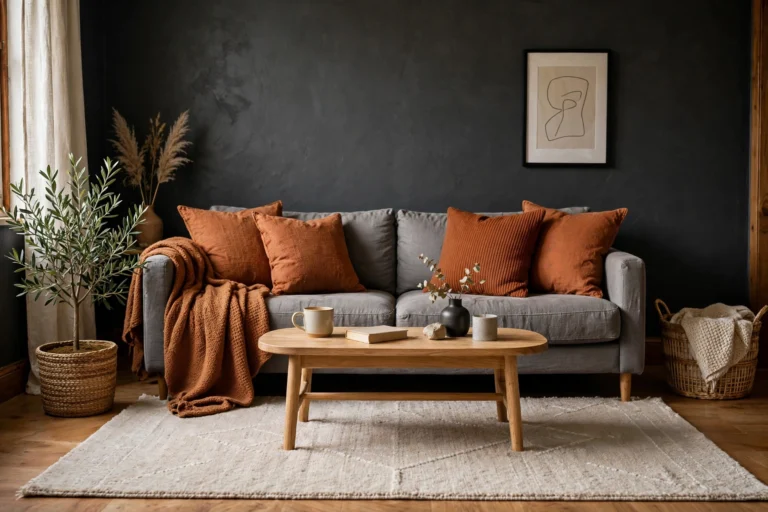 What if both your sofa and your walls are dark? Add a light rug with a warm pattern.Then add light cushions in cream, oatmeal, or rust. Finish with a light throw folded over the sofa arm.
 What if your walls are dark and your sofa is light? Then add dark cushions and a wooden coffee table.That grounds the light sofa. Otherwise, it can feel like it’s floating in the room.Curtains matter here too. Choose a warm neutral, like linen in oatmeal, cream, or soft taupe. Don’t go dark — unless you have two large windows and plenty of daylight.Why? A dark room with dark curtains on its only window loses its best light source. So keep one large, light element in the room at all times.It could be a light rug, a light sofa, or a large mirror with a light frame. That one element stops the room from feeling like a box.

Textiles that make a dark room soft
Dark rooms need more textiles than light rooms do. Hard surfaces reflect less light there, and they feel colder.So layer it up. A thick rug under the coffee table, a wool throw on the sofa, velvet or linen cushions, and a soft curtain all add warmth that paint just can’t.Choose warm tones for those textiles. Rust, mustard, terracotta, cream, and camel all work beautifully. Cool grey or pure white can look stark against dark walls, so use them with care.Layer each piece in a different texture. Start with a rug, then add a throw, then cushions, then a curtain. A room with a velvet sofa, a wool throw, and a linen curtain feels cozy even before the lamps are on. A room with a leather sofa, a glass table, and no rug feels cold even with the heating on.Got pets? Choose washable textiles in dark-friendly colors.Rust and camel hide pet hair better than cream does. And keep a lint roller in a side table drawer. You’ll thank yourself later.

Plants, art and life in a dark room
A dark room without plants can feel artificial. Plants add green, and green is the perfect partner for the warm tones in a dark room. They add life, too.If your dark room has only one window, pick plants that handle lower light well. Snake plants, ZZ plants, pothos, and ferns all do well in indirect light.A trailing pothos on a bookshelf is a great trick. It adds green at eye level without taking up any floor space. For art, go big and go warm. A landscape with autumn colors, a botanical print in warm greens, or an abstract in rust and cream all work well. Put it in a wooden or brass frame.Small, cool-toned art tends to get lost on a dark wall. So don’t be shy about size here.A large mirror in a warm frame adds life, too. It reflects lamplight and the room itself, which doubles the sense of space.
 Finally, add a scent. A candle in cedar, amber, or vanilla, lit in the evening, says “cozy” before anyone even sits down.
How to fix a gloomy dark room in a weekend
How do you do this in a weekend? Start on Saturday by auditing the room.Look at it in daylight, then again in lamplight. Note what’s dark, what’s cool-toned, and what’s hard.Swap cool bulbs for warm bulbs. Move a wooden tray or table into the room. Add a light rug or throw if you don’t have one yet. On Sunday, hang a large mirror opposite the window. Add plants, and set up three lamp levels.Don’t repaint on the first weekend. Live with the warmer light and textiles for a week first. Only repaint if the room still feels gloomy after those fixes.Here’s the most common mistake: repainting a dark room white out of frustration. Then you realize the room now feels cold and characterless. And the furniture that worked against dark walls no longer works.Warmth fixes are reversible. Repainting isn’t — at least not without another weekend of work.
What it actually costs
What does it cost to fix a gloomy dark room? Here’s the breakdown, without repainting or replacing the sofa.Warm bulbs and a dimmer: $30–$60. A floor lamp or table lamp: $60–$150.A thick rug: $120–$250. A wool throw and two cushions: $70–$150.A large mirror: $100–$220. Plants and pots: $50–$100. A wooden tray or coffee table accessory: $40–$90.That totals roughly $470–$1,020.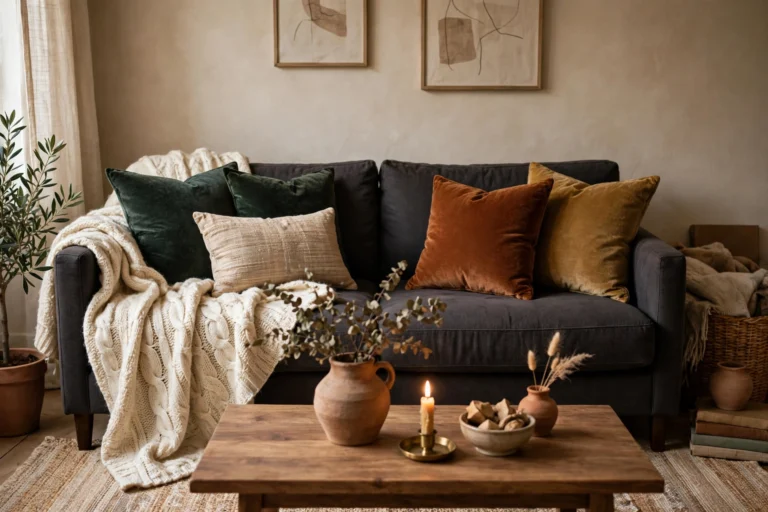 Want to repaint one wall in a warmer dark tone? For example, moving from cool charcoal to warm charcoal or deep green would add $70–$140 for paint and supplies.If your budget is under $300, spend it on warm bulbs, a throw and cushions, and one plant first. Those three change how the room feels every evening. And evening is when a dark living room is actually used.One tip: keep the receipt for the rug and mirror. Scale matters here. A rug that’s too small for the sofa grouping makes a dark room feel smaller, not cozier.
What to avoid
What should you avoid in a dark living room? Start with cool white bulbs, chrome and glass as the dominant materials, and dark curtains on a single window. All three cool a dark room down.Avoid a dark rug on a dark floor with a dark sofa and no light contrast. Without contrast, the room becomes one dark mass.Avoid cluttering a dark room with small, dark ornaments that disappear against the walls. Choose fewer, larger, warmer objects instead.Avoid using a single overhead light as your only source. It creates harsh shadows on dark walls.And avoid the idea that a dark room needs bright white to “balance” it. It doesn’t. It needs warm light, warm wood, and soft texture — not a white feature wall that fights the rest of the room.Balance in a dark room is warm versus dark, not white versus dark. See more: Living Room, Ideas by Room, Ideas by Style, 12 Stunning Dark Living Room Ideas to Create a Cozy Moody Space, Cozy Modern Living Room Design, and Top Living Room Decor Ideas for 2026.
FAQ
How do I make a dark living room cozy?
Add warm light at three levels, warm wood and brass, and soft textiles in rust, cream, and camel. Add a light rug or sofa for contrast, plus plants. Warmth, not brightness, is what makes a dark room cozy.
Thank you for reading this post, don't forget to subscribe!What colours go with dark living room walls?
Warm neutrals and warm accents work best: cream, oatmeal, rust, mustard, terracotta, camel, and warm wood. Avoid cool grey and stark white as the main accent, since they can look cold against dark walls.
Should I paint a gloomy dark living room white?
Not first. Try warm bulbs, textiles, a mirror, and plants for a week. Many gloomy dark rooms are gloomy because of cool light and hard surfaces, not the paint. Repainting white can make the room feel cold instead of cozy.