


Under the bed is your biggest wardrobe
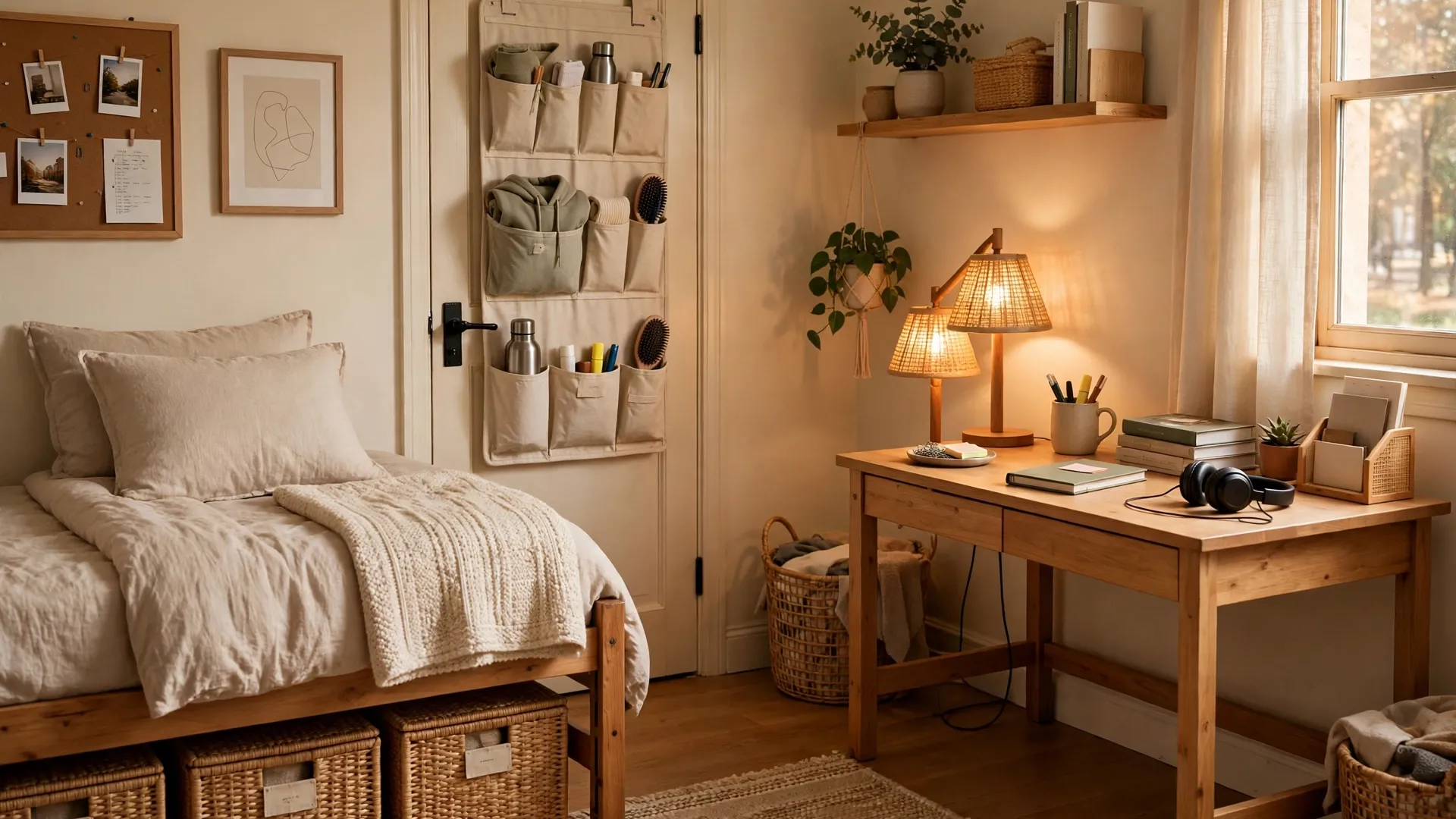
Most dorm beds can be raised. And that space underneath is the largest storage area in the room. Use it first.Flat, wheeled under-bed boxes hold out-of-season clothes, spare bedding, and bulky items like a winter coat. If your bed cannot be raised, bed risers can help. Check your dorm rules first, though. Some halls ban them, and you do not want a fine on move-in week. Risers can add 5 to 7 inches. Label each box on the short end, not the top. Why? Because you can read the label when the box is slid under the bed. A label on top is useless once the box is tucked away.Do not store food under the bed. And do not store anything you need in the dark without a small flashlight or phone light nearby. Fumbling under a bed at night is how boxes get left out — and then they become clutter.

The door, the wall and the vertical space you already have
In a dorm, vertical space is free. The back of the door holds an over-door hook rail for bags, coats, and a towel. Inside the wardrobe door, a hanging organizer for accessories, belts, and scarves stops them tangling in drawers. On the wall, use adhesive hooks within their weight limit. They work well for a bag, a cap, or a lanyard. Just do not hang heavy shelves with adhesive strips in a dorm.The wall surface is often painted block or plaster, and it does not hold well. A fallen shelf is a safety issue, as well as a deposit issue. It is not worth the risk. A tall, narrow freestanding shelf unit beside the desk or wardrobe uses vertical space without drilling. A bedside caddy that slips between mattress and frame holds a phone, book, water bottle, and charger.
Desk storage: keep the work surface clear
A dorm desk is for work, not storage. But it becomes storage by default when there is nowhere else to put things. Use a cable clip on the desk edge so chargers do not fall behind the desk.
Clothes, shoes and laundry in a shared room
Clothes storage in a dorm is about rotation, not capacity. Bring clothes for two to three weeks, not a whole season. Use the wardrobe for hanging items. Use a small drawer or hanging shelf organizer for folded items. Rolling clothes in drawers works better than folding them in stacks. For shoes, limit yourself to four pairs: everyday, sport, smart, and slippers. Store the rest at home or in an under-bed box. A slim shoe rack by the door works well, if your roommate agrees. Laundry needs a system, not just a basket. Try a divided laundry bag, or two bags — one for lights, one for darks. A collapsible laundry basket is another smart choice. Wash on a schedule, not when you run out of clothes. A dorm laundry room is busiest on Sunday night.
Toiletries, food and shared-space storage
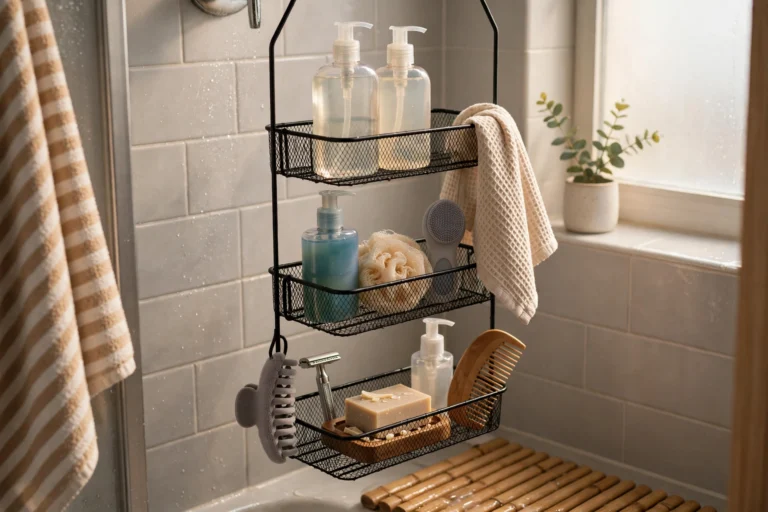
If you share a bathroom, a shower caddy you can carry is essential. Choose one with drainage holes, a handle, and separate sections so bottles do not tip. Keep it in your room, not in the shared bathroom, where it can be moved or knocked over. A small toiletry bag for daily items — toothbrush, skincare, medication — lives in a drawer or on a shelf. Not on a shared sink. For food, a small crate or box on a shelf unit holds snacks, tea, and a mug. A mini-fridge organizer helps, too. Do not store perishables in your room for more than a day. For study gear and tech, use a single tech pouch for cables, adapters, and a hard drive. You also will not lose a charger in a drawer full of loose cables.
How to set it up on move-in day
Move-in day is chaotic. So set storage up before you unpack decor. This order matters more than it sounds. First, raise the bed if allowed and slide under-bed boxes underneath, empty. Second, hang the over-door hooks and shoe organizer, and place the freestanding shelf unit. Third, unpack clothes into wardrobe and drawers, shoes into their place, and toiletries into the shower caddy. Fourth, set up the desk organizer and cable clips, and plug in chargers in their final places. Only then unpack decor, photos, and plants. At the end of move-in day, walk the room with your roommate. Agree on shared spaces: the door hooks, the fridge shelf, the bathroom caddy spot, and the laundry area.A five-minute agreement on day one prevents most roommate storage arguments later.
What it actually costs
What does dorm storage actually cost? Here is a realistic set. Under-bed boxes, two, $30–$60. Over-door hook rail, $15–$30. Over-door shoe organiser, $20–$35.Bedside caddy, $15–$25. Desk organiser and monitor riser, $30–$60. Hanging wardrobe organiser, $20–$35. Shower caddy, $20–$35. Laundry bag or collapsible basket, $20–$35. Tech pouch and cable clips, $15–$30.That totals roughly $185–$345. If your budget is under $150, buy under-bed boxes, the over-door organiser, and the shower caddy first. Those three solve the biggest dorm problems: clothes, small items, and shared bathroom gear.
 Buy clear or labelled boxes where possible.
What to avoid
What should you avoid in a dorm? First, avoid bringing everything you own. A dorm is a term, not a home. Excess stuff has nowhere to go, and it will end up in piles, no matter how good your storage is.Avoid adhesive shelves for heavy items. And check your hall rules before using bed risers, over-door hooks that damage paint, or any item that blocks a fire exit, radiator, or window. Also follow fire safety guidance for college housing for heaters, candles, and cooking appliances. Avoid storing valuables in open, visible places. Use a small lockable pouch or a drawer for a passport, laptop, and medication . Keep important items out of sight.
 Avoid a single giant storage box for “everything.” It becomes a rummage box where nothing can be found. And avoid buying storage before you arrive and measure. Dorm beds, wardrobes, and desk sizes vary by hall. A box that fits one hall’s bed will not fit another’s.Measure first, buy second. And keep receipts for anything you buy before move-in day, just in case it does not fit.
 See more: Bedroom, Ideas by Room, Smart College Dorm Room Ideas, and Easy DIY Home Updates.
FAQ
What is the best dorm storage for a very small room?
Under-bed boxes, an over-door shoe organiser, and a bedside caddy. Together they use dead space under the bed, behind the door and beside the mattress, without taking floor space or drilling.
Thank you for reading this post, don't forget to subscribe!How do I store clothes in a dorm with a tiny wardrobe?
Rotate clothes for two to three weeks, roll folded items in drawers so you can see them, use a hanging shelf organiser, and store out-of-season clothes in under-bed boxes. Bring fewer clothes, not more storage.
Can I use adhesive hooks in a dorm?
Usually yes for light items, if your hall allows them, but clean the surface, respect the weight limit, and remove them correctly at move-out. Do not use adhesive for heavy shelves, and check rules for painted block walls.